Havana: The Cultural Crossroads of Cuban Folklore
Explore how Havana became the cultural heart of Cuban folklore, blending music, dance, theater, religion, commerce, and national identity into one of the Caribbean’s most vibrant cultural crossroads.
Instituto Folklórico Cubano Americano
5/31/20264 min read
Havana: The Cultural Crossroads of Cuban Folklore
How the capital became a meeting place for music, dance, theater, religion, commerce, and national identity.
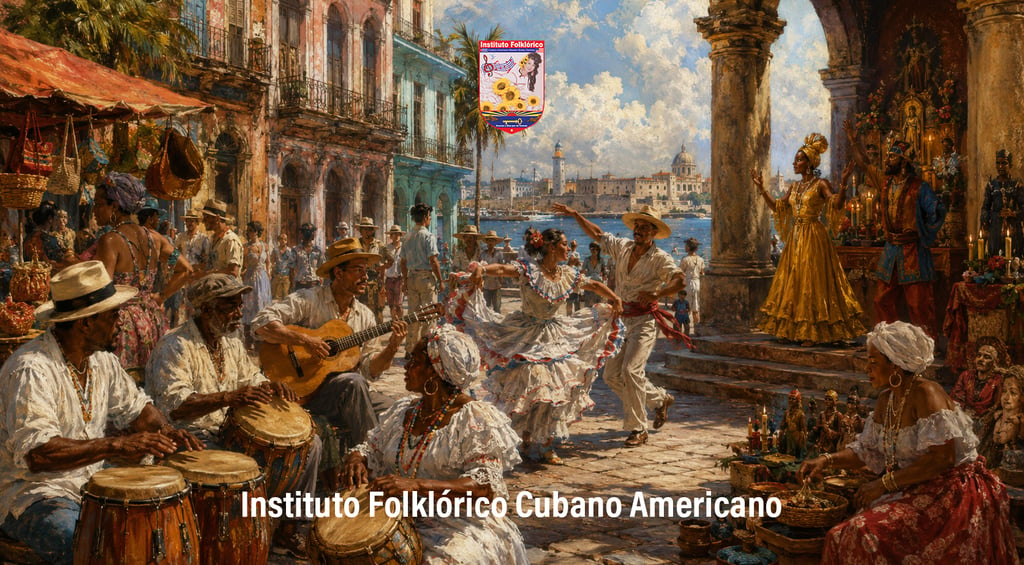
Havana has always been more than Cuba’s capital city. It is a living stage where history, rhythm, faith, movement, and memory come together. For centuries, people arrived in Havana by sea, bringing languages, beliefs, customs, instruments, recipes, songs, and dances. Some came freely in search of opportunity. Others were forced through the tragedy of slavery. Still others came through trade, migration, military life, or cultural exchange. Out of this constant movement, Havana became one of the most important cultural crossroads in the Caribbean.
Because of its location, Havana developed as a major port city. Ships connected it to Spain, Africa, the Caribbean, Europe, Mexico, and the United States. Goods passed through its harbor, but so did ideas. Music, fashion, religious practices, theatrical styles, dance forms, and popular celebrations all circulated through the city. Havana’s streets, plazas, theaters, churches, cabildos, markets, and private salons became places where different traditions met, adapted, and transformed.
One of Havana’s greatest contributions to Cuban folklore is its role as a musical meeting place. Spanish melodies, African rhythms, French-influenced dance forms, and Caribbean creativity all found room to grow in the city. In Havana, the refined elegance of contradanza and danza could exist alongside the deep percussion traditions of African-descended communities. Later, danzón, son, rumba, mambo, cha-cha-chá, and many other Cuban styles would be shaped, performed, popularized, and celebrated through Havana’s musicians, dancers, theaters, radio stations, social clubs, and dance halls.
Dance also found a powerful home in Havana. In the colonial and republican periods, formal ballroom dances were enjoyed in elite salons, while popular and Afro-Cuban dance traditions flourished in neighborhoods, patios, societies, and public celebrations. This contrast did not remain separate forever. Cuban culture often grows through encounter. The graceful steps of European social dance, the grounded power of African movement, and the joyful creativity of the Cuban people helped form dances that carried both elegance and fire. Havana became a place where the body itself could express identity.
Theater played an important role as well. Havana’s stages helped preserve and popularize Cuban characters, accents, humor, music, and social commentary. Through zarzuela, bufo theater, comedy, musical revues, and popular performance, audiences saw reflections of Cuban life. The stage became a mirror of the nation, presenting everyday people, local speech, street culture, and political feeling. Folklore was not only preserved in rural traditions or religious ceremonies; it also appeared under the theater lights, dressed in costume, music, satire, and dance.
Religion and spirituality added another deep layer to Havana’s cultural identity. Catholic processions, African-derived spiritual traditions, mutual aid societies, and sacred music all contributed to the city’s folklore. In Havana, religious life was not only found in churches. It also lived in homes, altars, songs, drumming, festivals, and community gatherings. Afro-Cuban religious traditions such as Regla de Ocha, Palo, and Abakuá helped shape music, rhythm, symbolism, and ceremonial expression. These traditions carried memory, resistance, identity, and continuity across generations.
Commerce also influenced Havana’s folklore. Markets, ports, tobacco factories, cafés, dance halls, and street vendors created spaces where people exchanged more than products. Workers sang, musicians performed, dancers gathered, and storytellers shared news and humor. Havana’s commercial life gave rhythm to the city. The sounds of street cries, carts, church bells, harbor activity, and musical gatherings became part of its atmosphere. Folklore grew not only in official institutions but in daily life.
As Cuba moved toward national consciousness, Havana became a center of identity. Writers, musicians, intellectuals, artists, dancers, and political leaders helped define what it meant to be Cuban. The city’s folklore became connected to the larger story of the nation. Cuban identity was not simply Spanish, African, Indigenous, French, Caribbean, or American-influenced. It was a unique blend formed through struggle, creativity, faith, resilience, and cultural pride. Havana gave that identity a public voice.
To understand Cuban folklore, one must understand Havana. The city gathered many traditions and allowed them to speak to one another. It turned the harbor into a gateway, the street into a stage, the dance hall into a classroom, the theater into a mirror, and the drum into a memory keeper. Havana became the place where Cuba’s many cultural roots did not disappear into one another, but instead formed something new, powerful, and unmistakably Cuban.
Today, Havana remains a symbol of cultural continuity. Its architecture, music, dance, religious traditions, festivals, and neighborhoods continue to tell the story of a people shaped by encounter and imagination. Havana is not only a city of the past. It is a living cultural crossroads where Cuban folklore continues to breathe, dance, sing, and remember.
Related Hashtags:
#Havana #CubanFolklore #CubanCulture #FolkloreCubano #CulturaCubana #AfroCubanCulture #CubanMusic #CubanDance #Danzon #RumbaCubana #SonCubano #OldHavana #CubanHistory #CaribbeanCulture #InstitutoFolkloricoCubanoAmericano